
One of the reasons I was so excited to visit Göttingen, the small University town where Stein completed the bulk of her University years, was because she wrote about the town in detail in her autobiography. In many ways, her description of the old town and her college haunts reads like a travel guide to the city. With Stein’s autobiography in hand, I followed my tour guide to explore the city she called home from 1913-1916.
Stop 1: Stein’s House (Lange Geismarstraße 2)
“The house was on Lange Geismarstraße, a narrow street typical of small towns, which led up from the center of town to St. Alban’s Churchyard. The house was No. 2” (Edith Stein, Life in a Jewish Family, 240).


Stop 2: St. Albani (Kirchhof and Church)
“The house was…next door to the Kirchhof: in Göttingen that was what they called the squares where the churches were located. The Albani Kirchhof lies at the boundary of the old town…St. Alban’s is the oldest of the churches, and it has a completely smooth facade and a massive tower. The bell still pealed the Angelus three times daily, thereby revealing its Catholic past. I heard the bell ringing; I did not know its significance” (240).


Stops 3-5: Lange Geismarstraße, Rathaus, Girl with Goose
“One had only to walk down Lange Geismarstraße and turn right at the corner to be directly to the Marktplatz. There was the beautiful Gothic Rathaus, the town hall; red geraniums bloomed at its windows, a cheerful contrast to the old gray stone. In front of it stood Schaper’s charming Fountain of the Goose Girl” (240).


Stop 6: Junkernhaus
“In one of the side streets not far from there was Göttingen’s most beautiful old house called the Mütze, and old-German tavern with framework gables and bull’s-eye glass for windows” (240).
I had to do a bit of sleuthing to figure out just which historic building Stein was talking about, but I’m so glad that I did!


Stops 7-9: Weenderstraße, St. John’s Church, St. James’ Church
“The town’s main strait, Weenderstraße, leads directly north from the Marktplatz…On the right side, approximately in Göttingen’s center, rises its landmark, the tall steeply of St. James’ Church. This and the two less stately towers of St. John’s Church are recognized as the town’s distinctive skyline when seen from a distance” (240).


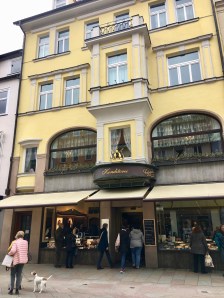
Stop 10: Kron und Lanz
“On the opposite side of the street is the famous pastry shop, Kron und Lanz, where the best tortes are made, and where, to the extent their purses will allow, professors and students take their afternoon coffee and read their newspapers” (240).
Stop 11: Auditorienhaus
“On the right side, the last house…is the Auditorienhaus, the lecture hall, central point of all life at the university” (240).

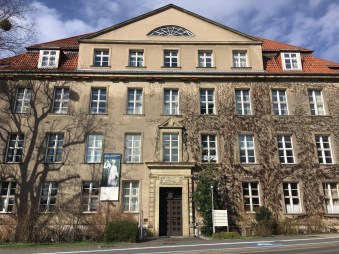
Stop 12: Seminar Building
“The nearby seminar building, around the corner to the right on the Niklausbergerweg, is more modern and more elegant” (240).
(All block quotes are from Stein’s autobiography, Life in a Jewish Family.)
 Europe with Edith